Sailing Terms for First-Time Guests: What You Need to Know Before Your Folly Beach Charter
Sailing Terms Every First-Time Guest Should Know Before Stepping on Board
There's nothing quite like your first sail out of Folly Beach. The marsh grass slips past, the Morris Island Lighthouse comes into view, and the wind takes over from there. But if you've never been on a sailboat before, the crew might as well be speaking another language for the first few minutes. "Watch the boom!" "We're coming about!" "Grab that line, not the rope!"
At Sailing the Edge of America, we want your time on the water to feel relaxed, not confusing. So before your next charter with us, here's a quick, friendly glossary of sailing terms for first-time guests — to help you talk (and think) like a sailor from the moment you step aboard. No experience required.
The Boat Itself
Bow and Stern: The bow is the front of the boat, the stern is the back. Easy way to remember it: if you're facing the bow, the wind is usually blowing toward you from ahead.
Port and Starboard: Left and right, but they don't change depending on which way you're facing — port is always the left side of the boat, starboard is always the right, based on facing the bow. Sailors use these instead of "left" and "right" because on a moving boat, "your left" and "my left" can mean two different things.
Hull: The main body of the boat — everything that sits in the water.
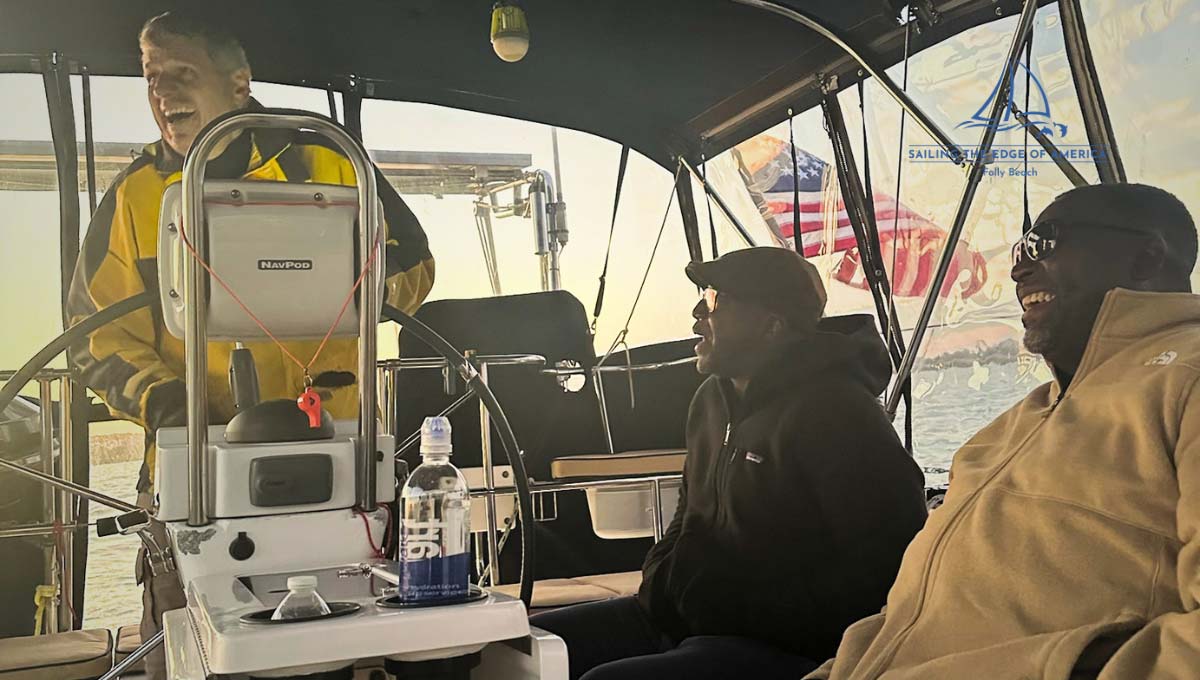
Cockpit: The open area where you'll usually sit, near the stern, close to where the captain steers.
Helm: The wheel or tiller used to steer the boat. "Taking the helm" means taking control of steering — and yes, on many of our charters, you'll get the chance to do exactly that.
For first-time sailing guests at Folly Beach, getting comfortable with these basic positions and parts takes about five minutes on the water — and our crew will walk you through all of it before we leave the dock.
Want to see the boat before you board? See the boat and the views for yourself in our photo gallery.

The Sails and Rigging
Mast: The tall vertical pole that holds the sails up. Hard to miss.
Boom: The horizontal pole attached to the bottom of the mainsail. This is the one word you actually need to know before you board, because when the boat changes direction, the boom swings across the cockpit. Our crew will always give you a heads-up — but now you'll know exactly what "watch the boom" means.
Understanding sailing terminology for beginners starts here — the boom is the one term that matters most for your safety, and our crew will always call it out before it moves.
Mainsail: The largest sail, attached to the mast and the boom. It does most of the work of catching the wind.
Jib (or Headsail): The smaller sail at the front of the boat, ahead of the mast. It works together with the mainsail to help the boat move efficiently.
Line: Rope, once it's on a boat. Sailors rarely say "rope" — everything from the sail controls to the anchor cord is called a "line." If someone asks you to hold a line, they mean a specific rope with a specific job, not just any old piece of cordage lying around.
Winch: A mechanical drum used to help pull in lines under tension. If you help crew, you might get to turn one of these.

Sailing Maneuvers
Tacking: Turning the bow of the boat through the wind to change direction — this is how a sailboat zigzags its way toward a destination that's upwind. Expect the boom to swing during a tack, and expect the crew to call it out beforehand.
Jibing (or Gybing): The opposite of tacking — turning the stern through the wind instead of the bow. This maneuver happens a bit faster, so the boom can swing more quickly. Again, your crew will keep you in the loop.
Knowing what to expect on a sailing charter at Folly Beach makes both of these maneuvers feel effortless — our captain narrates every move so you always know what's coming.
Wondering about the best time to book your Folly Beach sailing charter? We sail year-round and each season brings something different.
Coming About: Another way of saying "we're about to tack." If you hear this, it's your cue to keep your head down and stay clear of the boom.
Heeling: The natural leaning or tilting of the boat when the wind fills the sails. It can feel dramatic the first time it happens, but a well-trimmed sailboat is designed to heel — it's part of what makes sailing sailing. Our crew keeps things comfortable and won't push the boat further than our guests are enjoying.
Points of Sail: This refers to the boat's direction relative to the wind — whether you're sailing "close-hauled" (angled tightly into the wind), on a "reach" (wind coming from the side), or "running" (wind coming from behind). You don't need to memorize these, but it's a fun concept to ask the captain about once you're underway.

Odds and Ends Worth Knowing
Galley: The kitchen area on a boat, if there is one.
Head: The bathroom. One of the more famously confusing sailing terms for newcomers — but now you'll know before you need to ask.
Knot: A unit of speed on the water, equal to one nautical mile per hour. If the captain says you're doing "6 knots," that's roughly 7 miles per hour — which feels a lot faster with open water and salt air around you.
Nautical Mile: A slightly longer distance than a standard mile, based on the Earth's circumference. Sailors use nautical miles and knots instead of regular miles and mph — it's tradition, and it's also more useful for navigation.
Chart: A map, but for water. It shows depths, channels, hazards, and landmarks instead of roads.
This is part of what makes a private sailing charter near Charleston, SC so different from a larger tour boat — on a private charter, the captain explains what's happening in real time, turning every gust and course change into a moment of understanding rather than confusion.
Curious about the dolphins, pelicans, and shorebirds you might spot along the way? See our guide to what you'll see on a private sailing charter in Folly Beach.

FAQ: Sailing Terms for First-Time Guests at Folly Beach
Do I need to know sailing terms before my charter?
Not at all. Our crew will explain everything you need to know before we leave the dock, and they narrate every maneuver while we're underway. This glossary is just a fun way to feel a little more comfortable before you arrive — not a test. The most prepared guest is simply one who shows up ready to enjoy the water.
What does "watch the boom" mean on a sailing charter?
The boom is the horizontal pole attached to the bottom of the mainsail. When the captain tacks or jibes — changing direction — the boom swings across the cockpit. "Watch the boom" is your cue to duck or stay low. Our crew always calls this out before it happens, but knowing the term in advance means you'll react immediately rather than spending a moment trying to figure out what they mean.
What is the difference between port and starboard?
Port is the left side of the boat, starboard is the right — always based on facing the bow (the front). An easy memory trick: port and left both have four letters. On our charters, you'll hear these terms when the captain is navigating or pointing out something worth seeing on one side of the boat.
What should I expect on my first sailing charter at Folly Beach?
Expect a relaxed, personalized experience with a knowledgeable captain who genuinely loves these waters. We'll cover the basics before we leave the dock, answer every question you have, and adjust the pace of the sail to match your comfort level. Most first-timers are surprised by how quickly the terminology clicks — and by how much they enjoy being part of the experience rather than just a passenger.
Is a private sailing charter better for first-timers than a group tour?
Yes. On a private charter, you have the captain's full attention, the ability to ask questions freely, and a pace set entirely around your group. There's no crowd to feel self-conscious in front of, no rushing, and no one to keep up with. For first-timers especially, the private charter format makes the whole experience feel welcoming rather than overwhelming.
You Don't Need to Memorize Any of This
Here's the good news: you don't need to walk onto our boat with a vocabulary quiz ready. Our captains and crew are used to first-timers, and half the fun of a charter out of Folly Beach is picking up these terms naturally as you go — hearing "prepare to tack" a few times until it clicks, or catching yourself calling something a "line" instead of a rope by the end of the trip.
If you're planning your first time sailing charter, the most important thing to know is that no preparation is required beyond reading this — our crew handles everything else.
Whether you're joining us for a sunset sail, a dolphin-watching cruise, or a full day exploring the waters around Folly Beach and Charleston Harbor, our goal is simple: get you out on the water, teach you a thing or two if you're interested, and make sure you leave with a great story — and maybe a new word or two in your back pocket.
Before you board, check our guide to what to wear and bring on your Folly Beach charter so you arrive fully prepared.
Ready to put these terms to use? Book your private sailing charter at Folly Beach and come see the Lowcountry coastline the way it's meant to be seen — under sail, with the wind doing the talking.
